
Oklahoma Property Tax Records
Oklahoma property tax records are public documents kept by each county's Assessor and Treasurer offices. You can search tax roll data, look up assessed values, and check payment status online through state and county portals. All 77 Oklahoma counties give free access to basic property tax information. Whether you need to verify a current tax bill, find past payment history, or locate parcel data for a specific address, this guide points you to the right offices and online tools across the state.
Oklahoma Property Tax Overview
How Oklahoma Property Tax Records Work
Property taxes in Oklahoma are handled at the county level. Each county has an elected Assessor who values all real and personal property and an elected Treasurer who collects payments and manages tax rolls. The Oklahoma Tax Commission Ad Valorem Division provides oversight statewide and handles taxpayer education but does not directly collect taxes. That duty belongs to each county's elected officials. The OTC can answer general questions at (405) 319-8200 and offers downloadable forms at tax.ok.gov.
The assessor places a fair cash value on all taxable property as of January 1 each year. Under the Oklahoma Ad Valorem Tax Code in Title 68, real property is assessed at 11% of fair cash value. Personal property is assessed at 13.75%. Agricultural land gets valued on a use-value basis, not market value, which generally keeps farm tax bills lower than a pure market approach would produce. State law caps annual value increases at 3% for homestead and farm properties and 5% for all others. These caps reset when ownership changes.
Once the assessor certifies the tax roll each October, the Treasurer sends out statements in November or December. Tax bills can be paid in full or split into two equal installments. The first half or full amount must be paid by December 31. If you pay the first half by that deadline, the second half is due March 31. Delinquent taxes accrue interest at 1.5% per month. Properties with unpaid taxes for several years can go to the county's annual tax resale, held the second Monday in June. A drop box at the courthouse is available in many counties for after-hours payments.
The OkAssessor.com portal connects to all 77 county assessor offices and provides 24/7 access to property and tax data. The OKTaxRolls.com portal lets you search and pay taxes online for most participating counties. Searches run by owner name, parcel ID, property address, or tax ID number. Both portals are free to use for basic lookups.
The Tax Commission notes that property tax records are open to the public, including all appraised values and tax bills. You have a right to inspect these records at the county courthouse or through online portals. Assessment ratio studies are conducted annually to check that counties are valuing property fairly and consistently with state guidelines.
The Oklahoma Tax Commission provides forms, publications, and property tax guidance for all Oklahoma property owners through its Ad Valorem Division.

The OTC Ad Valorem Division monitors county assessors, sets statewide valuation guidelines, and publishes the Taxpayer Education Series (TES-14) to help residents understand the ad valorem tax process.
Search Oklahoma Property Tax Records Online
Several portals give you access to Oklahoma property tax records without visiting a courthouse. These are the primary resources for statewide searches.
The OkAssessor.com portal acts as the electronic customer service desk for Oklahoma's 77 county assessor offices. It provides free access to property ownership data, assessed values, and basic parcel information. Real estate professionals can access detailed appraisal records through a subscription. The site features an interactive Oklahoma map for county selection and is available 24 hours a day, 7 days a week. Much of the on-line information is free to download and use according to the portal's own description of its services.
OKTaxRolls.com is the statewide County Treasurer portal used by most Oklahoma counties. You can search tax rolls by owner name, property ID, tax ID, or street address. The site also supports online payment via eCheck, credit card, or debit card. Most counties accept half or full payments through this portal, and you can print receipts directly from the site. It also provides mortgage tax calculators and excess resale funds information for delinquent tax properties.
The statewide assessor portal at OkAssessor.com provides a central connection to all 77 Oklahoma county assessor databases in one place.
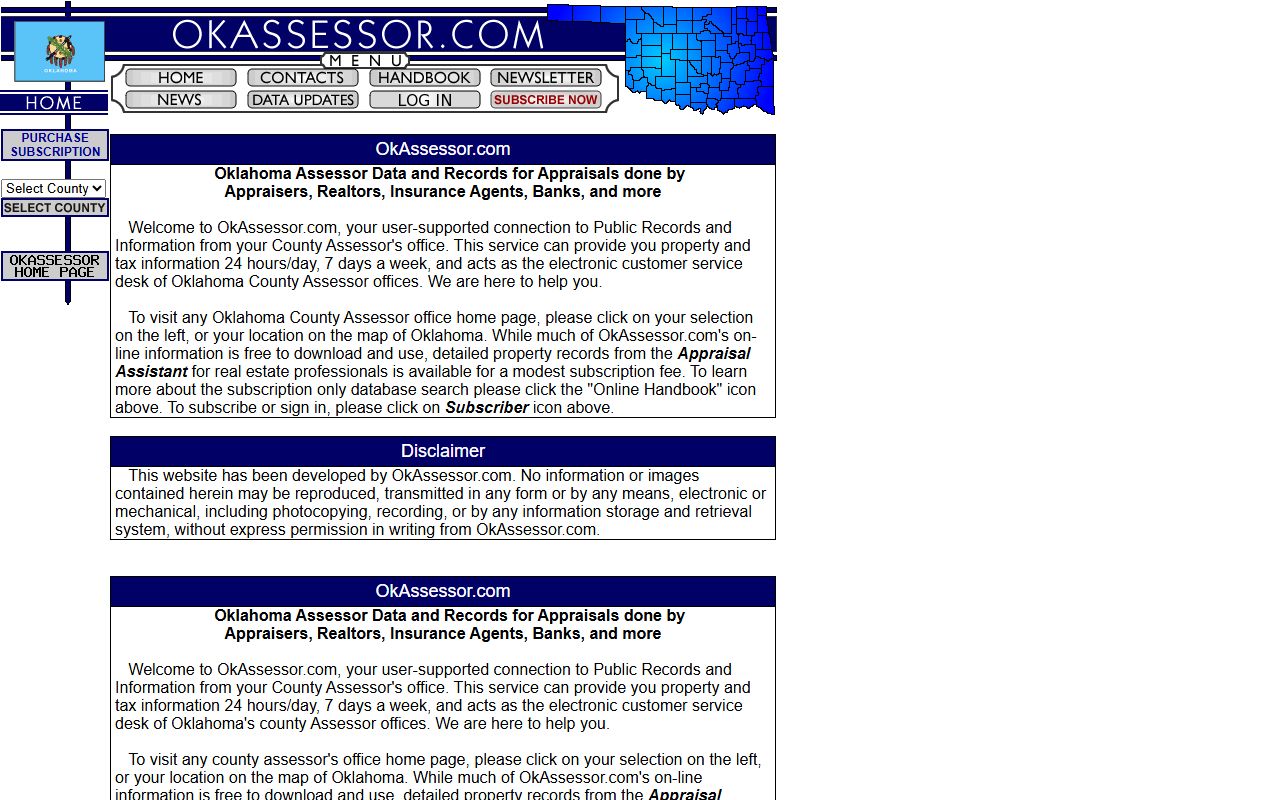
Assessor data includes ownership history, fair cash values, assessed values, and parcel maps for all participating counties, available free around the clock.
DataCrosspoint covers all 77 Oklahoma counties from a single search platform. You can access tax assessments, ownership history, and interactive parcel maps, and search by owner name or parcel ID. The platform provides millage rates, current and historical market values, and comparable sales analysis for residential and commercial properties. Premium analytics add mortgage records and automated valuations.
The OKTaxRolls.com tax roll portal lets property owners in most Oklahoma counties search records and pay ad valorem taxes directly online.
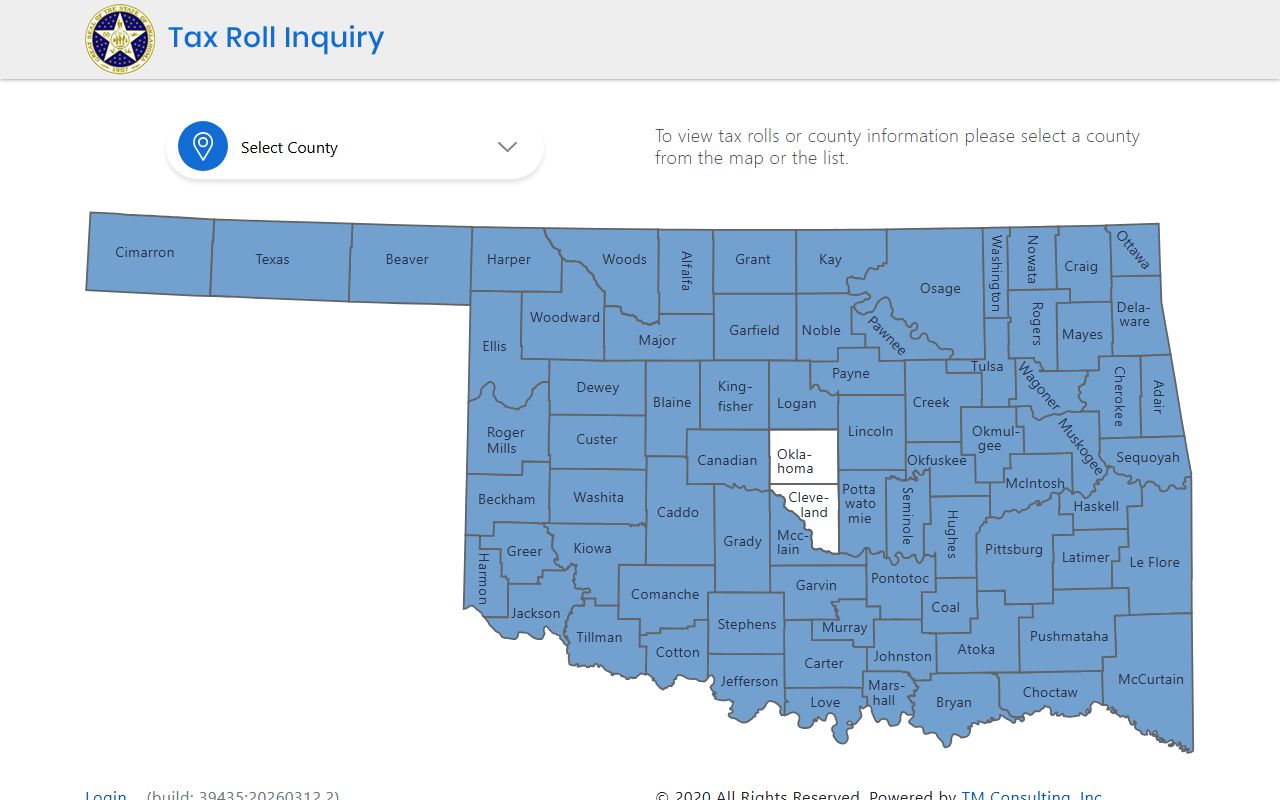
The portal shows current and past tax years, base tax amounts, total amounts due, and payment status, with multiple payment options including eCheck, credit card, and debit card for most participating counties.
Oklahoma Property Tax Assessment
County assessors are elected constitutional officers who serve four-year terms. Their primary duty is to discover, list, and value all taxable property in the county. Assessors must physically inspect each parcel at least once every four years under state law. Between inspections, they track permit activity, sales data, and changes in property use. Assessment notices are mailed each year between February and April. You have 15 working days from the notice date shown on OTC Form #974 to file a formal protest with the County Board of Equalization.
Oklahoma uses fair cash value as the basis for property assessment. Oklahoma Statutes Section 68-2817 defines fair cash value as the price property would bring at a fair voluntary sale in a competitive open market. Agricultural land is an exception to this rule. Farmland is valued using the income capitalization approach, based on cash rent and soil productivity indices. This method generally produces assessed values much lower than market-based assessments would. Soil types and agricultural use classification determine use value under this approach.
If property is damaged by fire, storm, or flood during the tax year, the assessor can reassess during that year. Transfer of real property without a change in use does not automatically trigger a new assessment based solely on the sale price, per state statute. Manufactured homes are assessed at 11% if classified as real property and at 13.75% if personal property.
The DataCrosspoint statewide property search covers all 77 Oklahoma counties and provides assessor records, parcel maps, and historical ownership data.

This platform offers owner name searches, parcel lookups with interactive mapping, tax assessment data, and comparable sales tools for properties across Oklahoma.
Note: Tax payments are updated through the close of business each day on OKTaxRolls.com, so allow at least one business day for online payments to reflect in the system.
Oklahoma Property Tax Payment Schedule
The Oklahoma property tax calendar runs on a fixed annual schedule. Knowing the key dates helps you avoid penalties and take advantage of payment options.
January 1 is the assessment date for all real property in the state. Between February and April, county assessors mail valuation notices to property owners. The deadline to file personal property returns (Form 901) is March 15, the same day applications for the homestead exemption are due. October 1 is when the County Assessor certifies the tax roll to the Treasurer. Tax statements are mailed in November or December. If you do not receive your statement by mid-December, contact your county treasurer's office right away. Failure to receive a tax statement does not exempt you from paying on time, per state statute.
December 31 is the deadline for the first half or full payment. Statements for $25 or less must be paid in full. If you pay the first half by December 31, the second half is due by March 31 of the following year. Some counties offer a 15-day grace period before interest begins. Delinquent interest accumulates at 1.5% per month, which works out to 18% annually. After several years of delinquency, properties go to the county tax resale auction held each second Monday in June.
Most counties now accept online payment via eCheck, credit card, or debit card through OKTaxRolls.com. eCheck fees are typically the lowest option, often just $1.50. Credit card fees run around 2.95% with a minimum charge. Visa debit cards often carry a flat $3.95 fee. In-person payments at the courthouse are also accepted, and many counties have drop boxes for after-hours submissions.
Note: Postmark date is accepted in most Oklahoma counties when meeting the December 31 and March 31 payment deadlines, so mailing your check before midnight counts.
Oklahoma Property Tax Exemptions
Oklahoma law provides several programs that reduce property tax bills for qualifying owners. The homestead exemption deducts $1,000 from the assessed valuation of your primary residence. Typical savings run $75 to $125 depending on local millage rates. To qualify, you must own and occupy the property on January 1. The deed must be filed by February 1, and the exemption application is due by March 15. Once approved, no annual renewal is required as long as ownership and residence remain unchanged. Forms are available at your county assessor's office or at tax.ok.gov.
An additional homestead exemption is available for households with gross income under $30,000. This provides a larger assessed value reduction for lower-income homeowners. The senior valuation freeze program is available to homeowners age 65 or older with household income within county-set limits, generally ranging from about $57,500 to $99,000 depending on location. This program locks your assessed value so taxes do not rise even if the property value increases. The freeze is removed if you sell the property, make substantial improvements, or transfer title.
A property tax refund is also available through the Oklahoma Tax Commission. It applies to persons age 65 and older or those who are totally disabled with gross household income under $12,000. The refund equals taxes paid minus 1% of household income, up to a maximum of $200. Use OTC Form 538-H and attach your property tax receipt. Call (405) 521-3108 for forms.
Oklahoma Land Records and Deed Search
County Clerk offices maintain deed records, mortgages, mineral interests, plats, and other instruments affecting real property. The OKCountyRecords.com portal provides online access to County Clerk land records for multiple Oklahoma counties. Search by grantor or grantee name, legal description (Section/Township/Range), instrument type, and date range. Copy fees typically run $1.00 per page, with an extra $1.00 for certified copies.
The land records portal at OKCountyRecords.com provides access to deeds, mortgages, liens, and other recorded documents from multiple Oklahoma county clerk offices.
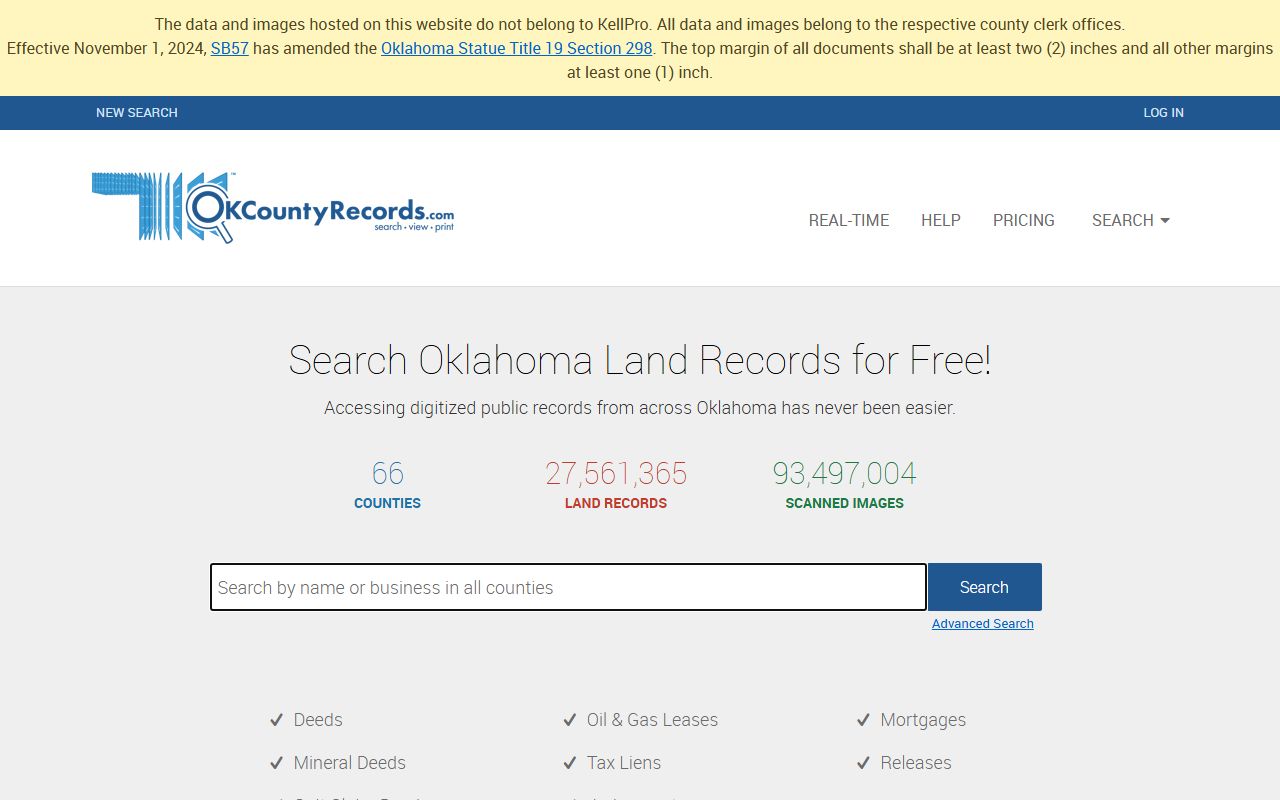
Searches run by name, date range, document type, or legal description, with real-time access to scanned document images from participating counties going back to the dates each office first indexed records.
Oklahoma County Assessor Directory
Each of Oklahoma's 77 counties has an elected assessor responsible for valuing local property. Oklahoma County is the largest, with Assessor Larry Stein managing more than 360,000 accounts across 720 square miles. Total market value tracked by Oklahoma County exceeds $105 billion, representing more than 22% of all ad valorem value in the entire state. More than 25 million individual visitors searched the Oklahoma County Assessor website in a recent year. Tulsa County, the second-largest, manages a large urban assessment roll through Assessor Ken Yazel.
The statewide assessor portal lists contact information and office details for elected assessors across Oklahoma's 77 counties.
County assessors are responsible for listing, appraising, and certifying the annual assessment roll that becomes the basis for all property tax bills in their county.
Assessors must conduct visual inspections of each parcel at least once every four years. Between cycles, they track construction permits, sales data, and use changes. Assessment notices are mailed each spring, and taxpayers have 15 working days from the notice date to protest. Most counties handle formal protests in the spring before the tax roll is certified to the Treasurer. Contact your local assessor office through the OkAssessor.com directory or call the OTC Ad Valorem Division at (405) 319-8200 with general questions.
Oklahoma Property Tax Law and Statutes
Oklahoma's property tax laws are found in Title 68 of the Oklahoma Statutes, which governs all Revenue and Taxation law in the state. Articles 28 through 31 of Title 68 form the Ad Valorem Tax Code. These articles define how property is classified, valued, assessed, and taxed. They also set out procedures for appeals, exemptions, and tax sales. Assessment percentages are prescribed in Section 8 of Article X of the Oklahoma Constitution.
The Oklahoma tax statutes at law.justia.com provide access to Title 68, which contains the complete Ad Valorem Tax Code governing property tax administration statewide.
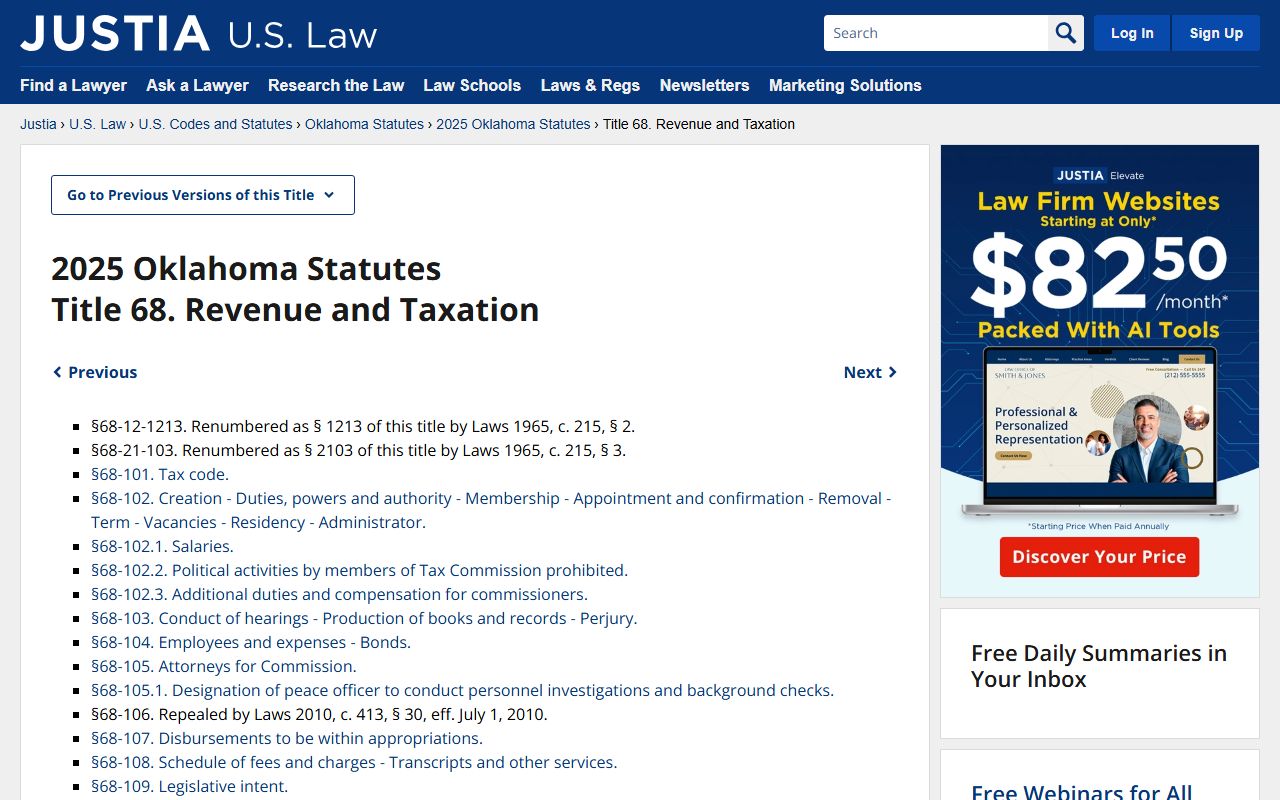
Title 68 covers assessment ratios, valuation methods, exemption rules, payment schedules, and delinquent property sale procedures for all 77 counties.
Key statutory provisions include the 11% assessment ratio for real property and 13.75% for personal property. The use-value method for agricultural land and the 3% and 5% annual caps on assessed value increases are also codified in this title. Tax resale procedures for delinquent properties require county treasurers to mail certified notice to owners and mortgage holders and advertise in local newspapers for four consecutive weeks before any auction. Excess proceeds from tax sales are held by the Treasurer for up to one year and may be claimed by the record owner.
Note: County assessors are bound by the Ad Valorem Tax Code and may not waive state-mandated assessment ratios. Contact the Oklahoma Tax Commission at (405) 319-8200 if you believe your county is not following state valuation standards.
Browse Oklahoma Property Tax Records by County
Property tax records in Oklahoma are held at the county level. Each of the 77 counties keeps its own assessment roll and tax roll through its Assessor and Treasurer offices. Select a county below to find local contact information, search portals, and resources specific to that area.
Oklahoma Property Tax Records by City
Residents of major Oklahoma cities access property tax records through the county assessor and treasurer serving their location. Select a city below for local office details and search tools.